
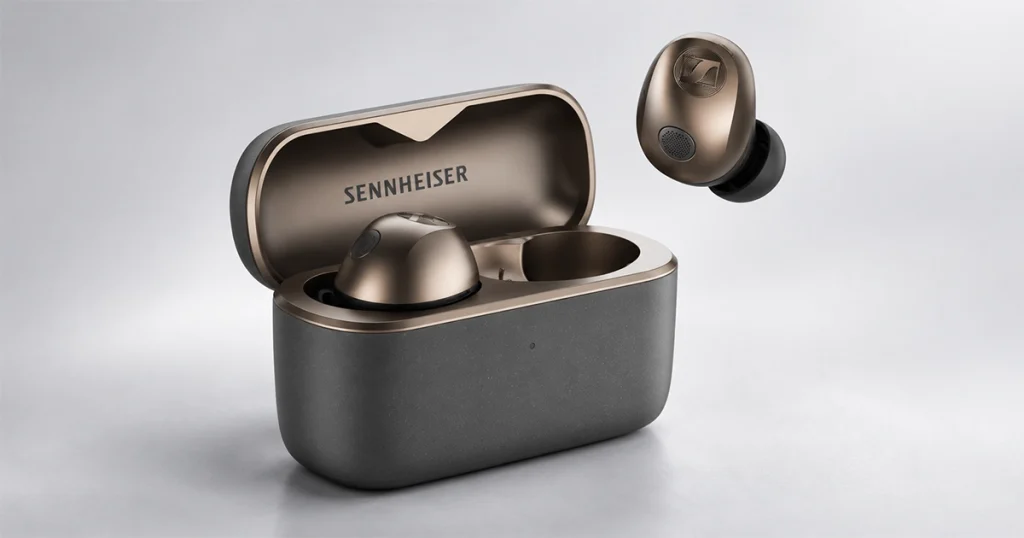
Premium wireless earbuds are getting better at cancelling noise, delivering detailed sound, and connecting to multiple devices. But most still share one frustrating weakness: when their tiny batteries wear out, replacing them can be difficult or impractical.
The Sennheiser Momentum True Wireless 5 takes a different approach. Alongside redesigned earbuds, Dolby Atmos spatial audio, Bluetooth 6.0, and upgraded noise cancellation, Sennheiser has introduced user-replaceable batteries in both earbuds and the charging case.
Announced on August 20, 2026, and launched in the US on September 3 at $299.95, the fifth-generation Momentum earbuds are designed for listeners who want premium sound without sacrificing convenience or long-term ownership.
But does a longer feature list make them a better purchase than their predecessors—or top rivals from Sony, Bose, and Technics?
This review examines Sennheiser’s official specifications, independent measurements, published listening assessments, and practical limitations to answer that question. You can also explore the official Sennheiser launch announcement.
High-performance earbuds
Quick verdict: Are the Momentum True Wireless 5 worth it?
Recommended for sound-focused buyers
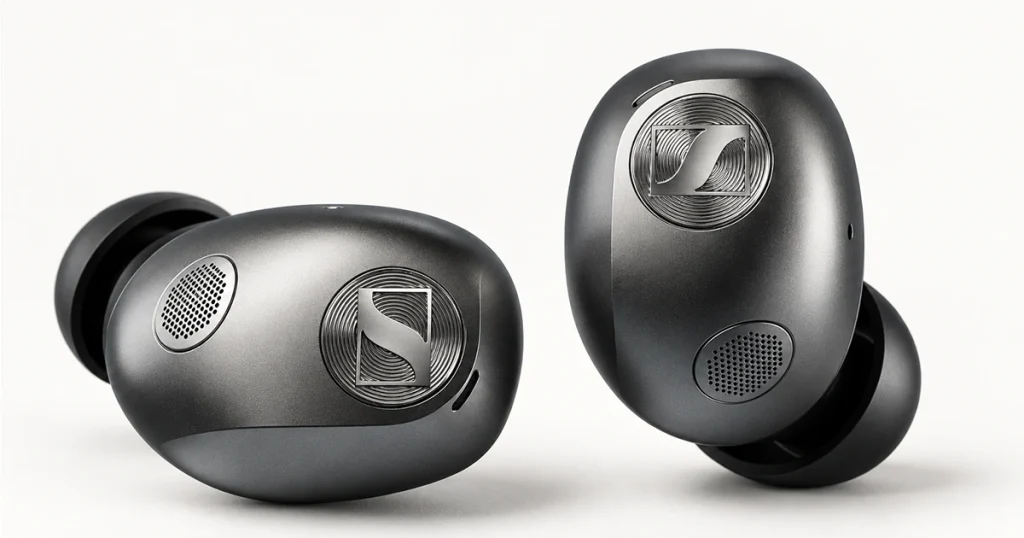
The Momentum True Wireless 5 are among the more compelling premium earbuds of 2026, particularly for people who appreciate detailed audio, strong customization options, and the possibility of replacing worn-out batteries.
What stands out: Excellent reported sound clarity, comfortable redesigned housings, capable ANC, extensive audio settings, and improved repairability.
What holds them back: A premium price, ANC that is not consistently class-leading, mixed call-quality assessments, and advanced audio features that depend on compatible devices.
Independent reviewers offer broadly positive conclusions, although their priorities differ. What Hi-Fi?’s September 2026 review particularly praises detail and musical organization, while identifying limitations in the highest frequencies and noise cancellation.
What Hi-Fi?
Our assessment: These earbuds deserve a place on a premium buyer’s shortlist, but they are not the automatic best option for every listener. Their strongest appeal is the combination of sound quality, extensive features, and unusually repairable batteries.
Sennheiser Momentum True Wireless 5 specifications
| Feature | Details |
|---|---|
| Product | Sennheiser Momentum True Wireless 5 |
| Type | True wireless in-ear earbuds |
| Original US price | $299.95 |
| Drivers | 7mm TrueResponse dynamic drivers |
| Bluetooth | 6.0 |
| Codecs | SBC, AAC, aptX, aptX Adaptive, including supported Lossless/Hi-Res modes |
| Noise cancellation | Adaptive ANC |
| Spatial audio | Dolby Atmos with head tracking |
| Microphones | Four per earbud, including voice-sensing hardware |
| Battery life | Up to 12 hours per earbud; 40 hours with case |
| Wired charging | USB-C |
| Wireless charging | Qi |
| Water/dust resistance | IP54 for the earbuds |
| Companion app | Sennheiser Smart Control Plus |
| Replaceable batteries | Yes, earbuds and charging case |
| Colors | Graphite, Cream, Copper, Denim, Lavender |
These are the manufacturer’s stated specifications and capabilities. Check Sennheiser’s official product FAQ for device requirements, feature behavior, and charging details.
Before you start – Sennheiser Hearing
1. Design, build quality, and comfort: A meaningful redesign
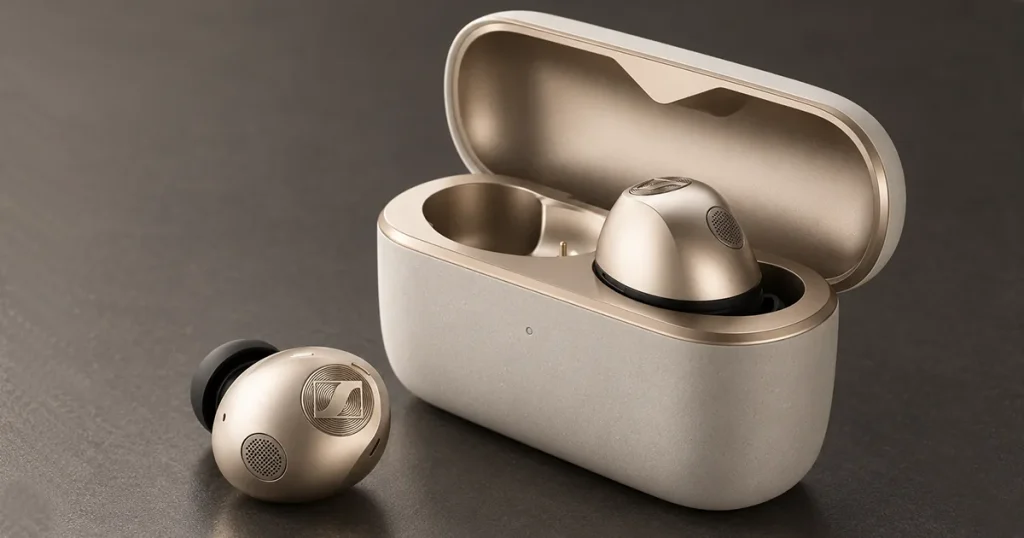
Sennheiser has changed more than the exterior finish this time. The Momentum True Wireless 5 features a reshaped housing that sits lower in the ear, a redesigned charging case, and a fit intended to feel more natural over extended listening sessions.
Unlike the Momentum True Wireless 4, which included silicone stability fins, the new design relies more heavily on the housing geometry and ear-tip seal for stability.
Four ear-tip sizes—XS, S, M, and L—are included. Choosing the right size is essential because the seal influences comfort, bass reproduction, passive isolation, and active noise cancellation.
The earbuds also carry an IP54 rating, which provides protection against dust ingress at the specified rating level and splashing water. That makes them suitable for everyday exposure to sweat or light rain, but not swimming or submersion.
Are they comfortable enough for long listening sessions?
Comfort remains subjective, but published testing is encouraging. RTINGS found the updated shape comfortable and suitable for exercise, although users who relied on the previous generation’s stability fins may need time to adjust.

The redesigned case also improves portability, making these earbuds more appealing to people who carry them in a trouser pocket rather than a large bag.
For a detailed independent evaluation of fit, build and everyday usability, see the RTINGS Momentum True Wireless 5 lab review.
RTINGS.com
CONVISI’s assessment: The design changes are a practical improvement for many users, but comfort should never be judged from specifications alone. Buy from a retailer with an appropriate return policy if fit is a concern.
2. Sound quality: The biggest reason to consider these earbuds
The Momentum True Wireless 5 continues using Sennheiser’s 7mm TrueResponse dynamic driver architecture. That might sound underwhelming to shoppers expecting larger drivers with every new generation, but driver diameter alone does not determine sound quality.
The acoustic housing, tuning, internal processing and fit are all important. Sennheiser says this generation has a cleaner bass presentation, more balanced midrange and increased openness in the upper frequencies compared with its predecessor.
How do they actually sound?
Independent reviewers broadly describe a detailed and controlled listening experience.
The SoundGuys comprehensive review identifies sound quality as a major strength, while noting that the treble can sound unusual in places. This suggests listeners sensitive to brighter higher frequencies may benefit from equalizer adjustments.
SoundGuys
TechRadar’s testing reaches an enthusiastic conclusion about the natural sound presentation, clarity and overall listening experience. Its reviewer used the earbuds with several devices over more than two weeks, providing practical context for the findings.
Read the TechRadar hands-on review for those observations.
TechRadar
What about aptX Lossless and Hi-Res audio?
The Momentum True Wireless 5 supports advanced Bluetooth audio modes, including:
- AAC and SBC: Broad compatibility, including standard wireless playback on iPhones.
- aptX Adaptive: A codec family designed to adapt wireless audio transmission to device capabilities and connection conditions.
- Hi-Res mode: Supports up to 24-bit/96kHz under compatible conditions.
- aptX Lossless: Enables supported lossless 16-bit/44.1kHz transmission when the source device and connection meet the requirements.
There is an important distinction: high-resolution audio and lossless audio do not mean exactly the same thing.
A higher sample rate does not automatically guarantee an audible improvement, and advertised codec support on the earbuds is not enough. The transmitting phone must also support the relevant codec and features.
For background on why Bluetooth settings, device compatibility and earbud fit affect listening quality, see Tom’s Guide’s Bluetooth sound-quality explanation.
and how to fix them
Eight-band EQ and Sound Personalization
If you find the default sound too bright, too warm or insufficiently bass-heavy, the Smart Control Plus companion app provides an eight-band equalizer and Sound Personalization.
This is especially valuable with premium earbuds because personal preferences and individual ear anatomy can influence the listening experience.
CONVISI’s assessment: Sound is the product’s strongest traditional selling point. The combination of detailed tuning and substantial customization makes the Momentum True Wireless 5 particularly attractive for serious music listeners.
3. Active noise cancellation: Strong, but not the undisputed best
Premium earbuds are often purchased as much for quiet as for music. The Momentum True Wireless 5 uses adaptive active noise cancellation, which adjusts its processing in response to surrounding conditions.
Its ANC system is intended to reduce repetitive background sounds such as traffic rumble, ventilation noise, and engine noise. It also features adaptive anti-wind processing to help manage wind interference.
However, ANC performance depends on frequency, ear-tip fit and environmental conditions. A product that does well against low-frequency noise will not necessarily eliminate voices or sudden sounds equally effectively.
How effective is the ANC in testing?
SoundGuys’ published product measurements give the earbuds an ANC category score of 8.5/10, although this is the publication’s own scoring system rather than a universal standard.
See the SoundGuys product performance breakdown for its category measurements.
SoundGuys
Other listening reviewers consider the cancellation competitive, but still find advantages in some Sony and Bose alternatives.
Transparency mode
Transparency mode uses external microphones to bring environmental sounds into the listening experience. It’s useful when ordering coffee, hearing announcements, or having a short conversation without removing both earbuds.
It is a convenience feature, not a guarantee that every important environmental sound will be audible. When crossing roads or moving through hazardous environments, paying direct attention to your surroundings remains essential.
CONVISI’s assessment: Noise cancellation is good enough to be a serious part of the buying decision. But buyers seeking the strongest possible ANC above everything else should compare competing flagship earbuds before purchasing.
4. Microphone and call quality: Advanced hardware with mixed results
The Momentum True Wireless 5 features four microphones per earbud, incorporating voice-detection technology and AI-assisted speech isolation.
This system aims to distinguish speech from external noise, making calls more intelligible when walking through crowded streets or taking meetings away from a quiet room.
Sennheiser also includes adaptive wind management, which is relevant when taking calls outdoors.
Nevertheless, advanced microphone hardware does not automatically mean the clearest transmitted voice. Aggressive noise suppression can sometimes alter the natural character of speech.
Some reviewers are positive about the improvements, while others remain less impressed by call quality than by music performance.
The SoundGuys video review provides another way to explore its testing and microphone discussion before making a purchase.
CONVISI’s assessment: Call quality looks adequate for general-purpose usage, but anyone purchasing primarily for frequent outdoor business calls should examine independent microphone samples rather than relying solely on the advertised AI features.
5. Battery life and charging: Good endurance, with an important catch
Sennheiser advertises up to 12 hours of playback on a single charge and up to 40 hours in total with the charging case.
These are maximum manufacturer figures, not promises of identical endurance under every listening setting.
Playback volume, ANC usage, wireless codec, spatial processing and environmental conditions can influence real-world battery consumption.
Advertised versus real-world battery life
SoundGuys recorded approximately 6 hours and 17 minutes under its ANC-enabled testing conditions.
That should not be read as proof that the manufacturer’s maximum figure is false: the two numbers refer to different operating conditions. It does show why buyers should not assume they will get 12 hours while using every premium feature continuously.
The charging features are convenient:
- USB-C charging for the case.
- Qi wireless charging for compatible charging pads.
- Approximately 1.5 hours for a full charge, according to Sennheiser.
- A claimed additional hour of playback from about eight minutes of quick charging.
Charging times may vary with the charger and conditions.
Sennheiser provides additional charging instructions through its official manual and download section.
CONVISI’s assessment: Battery performance is competitive enough for normal commutes, workdays with breaks, and travel. The more important long-term benefit, however, may be that users can replace degraded batteries.
6. Replaceable batteries: The feature that changes the ownership experience
This is arguably the most consequential upgrade in the entire product.
Lithium-ion batteries gradually lose capacity through age and charging cycles. In many compact wireless earbuds, battery replacement is difficult enough that owners eventually replace the whole set.
The Momentum True Wireless 5 addresses that problem with replaceable batteries in both earbuds and the case.
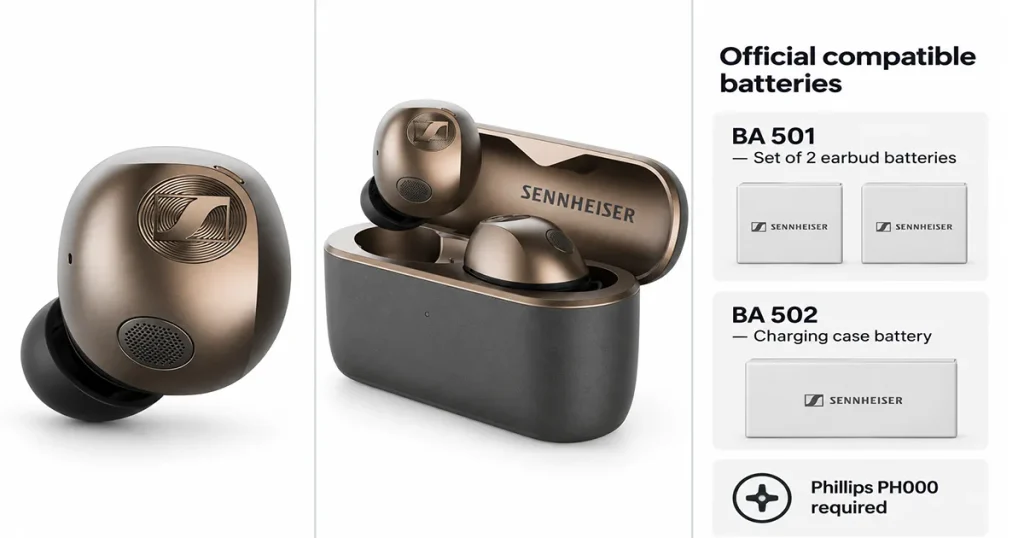
Sennheiser identifies two replacement products: BA 501, containing a pair of earbud batteries, and BA 502 for the charging case.
These replacement parts are planned for availability in the European Union and selected additional countries. Availability and local pricing should be verified before assuming they can be purchased in your region.
How does battery replacement work?
The earbud housings can be opened using an appropriately sized Phillips screwdriver and a careful opening procedure. The battery is then exchanged using compatible parts.
The operation involves delicate internal connections, so it should not be approached like swapping ordinary AA or AAA batteries.
A damaged connector, incorrect battery, or improperly closed housing can create functional or safety problems. Owners should follow Sennheiser’s official procedure and avoid unsupported replacement cells.
The official Momentum True Wireless 5 operating and maintenance guidance is an important starting point before attempting service.
Operation – Sennheiser Hearing
Does this make the earbuds sustainable?
Replaceability is a meaningful improvement in repairability, but it should not be treated as proof that the entire product is environmentally sustainable.
Manufacturing, transport, material extraction, spare-parts availability and responsible disposal all affect a product’s environmental impact.
Even so, a replaceable battery removes one common obstacle to longer ownership. It could also improve value if the remaining hardware continues working reliably.
CONVISI’s assessment: This is the Momentum True Wireless 5’s clearest competitive differentiator. It gives buyers a practical reason to consider long-term ownership rather than treating premium earbuds as short-lived accessories.
7. Bluetooth 6.0, app features, and everyday connectivity
The Momentum True Wireless 5 supports Bluetooth 6.0, making it one of the more technologically up-to-date products in Sennheiser’s true wireless lineup.
However, a newer Bluetooth version does not automatically mean noticeably better sound or lower latency with every device. Actual functionality depends on the earbuds, transmitting device, supported profiles and firmware.
Multipoint connectivity
Bluetooth multipoint allows the earbuds to maintain connections with two compatible devices, such as a smartphone and laptop.
That can make everyday switching more convenient. You might be listening to music from your computer when a phone call arrives, without needing to manually disconnect and pair the earbuds again.
Users should still check how their chosen codecs and priority modes interact with multipoint operation.
Smart Control Plus app
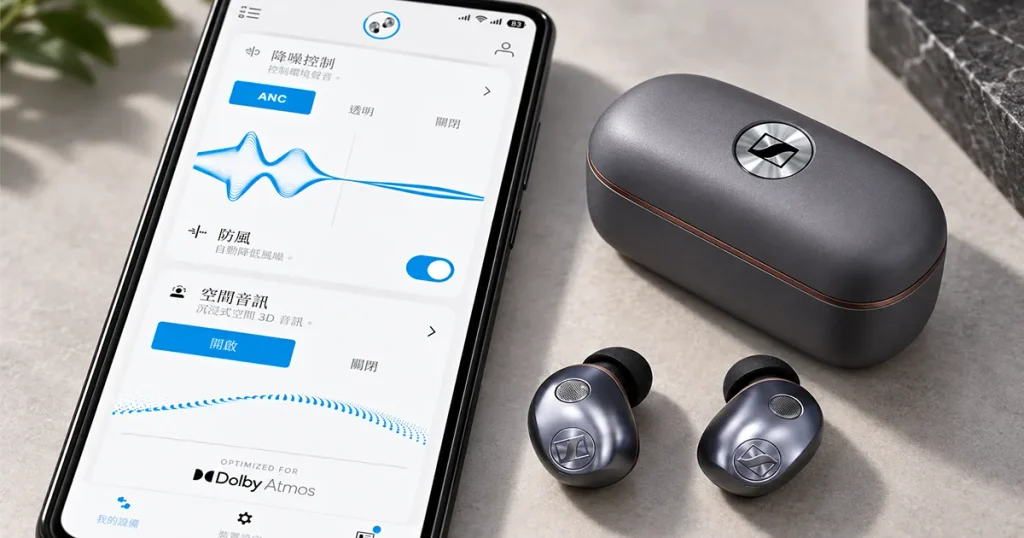
The Sennheiser Smart Control Plus application is central to the experience. It provides access to sound customization, firmware management, control adjustments and other device settings.
You can find the official application through the Apple App Store and Google Play Store. Feature availability can differ across models, phones and application versions.
Customizable touch controls
The earbuds also support configurable touch gestures for common actions such as controlling music, handling calls, and accessing supported voice assistants.
This matters because users have different preferences. Someone who changes songs frequently might want playback commands readily accessible, while a commuter might prioritize switching between ANC and transparency mode.
Another useful capability is independent single-earbud operation, allowing either earbud to be used on its own.
What about LE Audio and Auracast?
The Momentum True Wireless 4 included LE Audio-related capabilities, making it especially important not to assume that a newer Bluetooth number means every older feature carries forward.
In its September review, RTINGS identifies the lack of Bluetooth LE codec support as a limitation of the Momentum True Wireless 5.
For context, the Bluetooth SIG’s official explanation of LE Audio describes the underlying technology and Auracast broadcast audio.
CONVISI’s assessment: Connectivity and customization are strong, but buyers who specifically need LE Audio or Auracast should verify current compatibility and firmware support instead of making assumptions based on Bluetooth 6.0 branding.
8. Dolby Atmos spatial audio and head tracking: Is it genuinely useful?
Spatial audio attempts to create a more immersive listening environment by making sounds appear to come from different positions rather than only from the left and right earbuds.
The Momentum True Wireless 5 introduces Dolby Atmos spatial audio support with head tracking.
Head tracking is designed to adjust the perceived position of compatible spatial sound as the listener moves their head. When implemented with suitable content, it can make audio feel less confined to the earbuds.
Does every song sound better with spatial audio?
Not necessarily.
Results depend on the source material, compatible playback software, device support and personal preference. Some users prefer the sense of space created by spatial processing; others prefer conventional stereo for music.
Spatial processing should not be considered an automatic sound-quality upgrade. It changes the presentation, which may or may not suit a particular recording.
Sennheiser demonstrates the new generation’s broader feature set in its official Momentum True Wireless 5 introduction video.
CONVISI’s assessment: Dolby Atmos adds versatility, particularly for people who regularly enjoy compatible movies and spatial audio recordings. Nevertheless, conventional stereo performance remains the more important consideration for many music-focused buyers.
9. Real-world performance: What independent testing tells us
Specifications provide a useful starting point, but they cannot fully explain what a product is like to use every day.
A premium pair of earbuds needs to perform across several very different situations.
During commuting
Adaptive ANC and passive isolation should help reduce steady background noise. Independent testing suggests capable performance, though not necessarily the strongest in the category.
At work
Multipoint connectivity, customizable controls and transparency mode are useful for switching between music, calls and conversations.
During exercise
IP54 protection and the redesigned shape make the earbuds relevant for ordinary gym sessions, although fit security can vary between users.
For focused music listening
Detailed reproduction, sound personalization and compatible high-quality codecs are among the strongest reasons to choose this model.
These are practical use-case assessments drawn from the feature set and independent reviews—not claims that CONVISI personally tested the earbuds in those environments.
The critical distinction is that the Momentum True Wireless 5 appears to perform well across multiple uses without necessarily leading every individual category.
For additional context on the competitive premium-earbud market, see TechRadar’s launch analysis.
10. Sennheiser Momentum True Wireless 5 vs True Wireless 4: What’s changed?
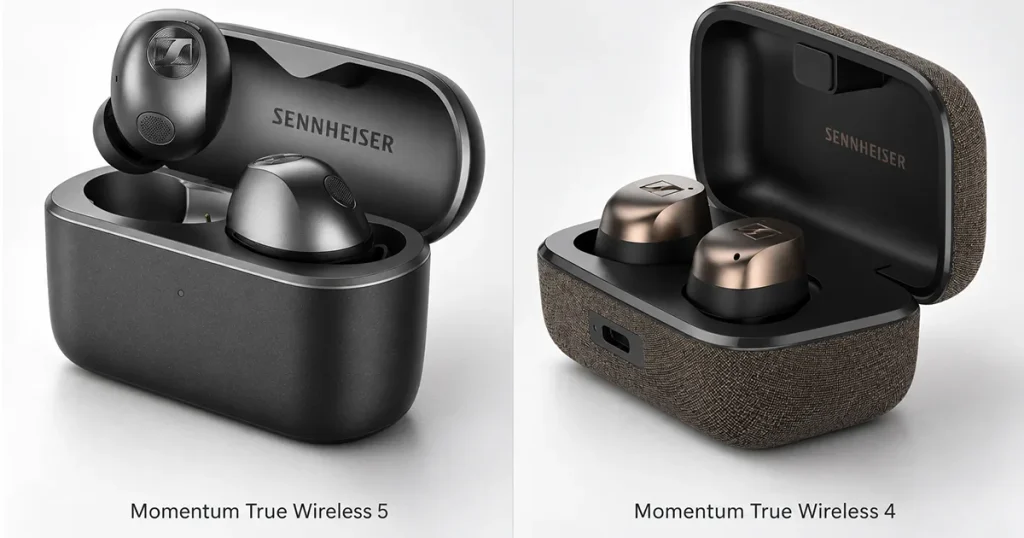
Momentum True Wireless 5
2026 generation
Momentum True Wireless 4
2024 generation
The previous-generation Momentum True Wireless 4 was already a highly capable product. Its sound quality, advanced codecs, noise cancellation and customizable controls made it competitive in the premium market.
That means the fifth generation must deliver meaningful improvements rather than simply offering a new name.
| Feature | True Wireless 5 | True Wireless 4 |
|---|---|---|
| Launch year | 2026 | 2024 |
| Bluetooth | 6.0 | 5.4 |
| Driver | 7mm TrueResponse | 7mm TrueResponse |
| Adaptive ANC | Revised system | Yes |
| Spatial audio | Dolby Atmos with head tracking | No comparable built-in feature |
| Battery replacement | User-replaceable batteries | Not user-replaceable |
| Earbud design | Redesigned without stability fins | Previous housing with stability fins |
| Sound EQ | Eight-band | Less extensive customization |
| Battery claim | Up to 12 hours, 40 total | Up to 7.5 hours, 30 total |
| LE Audio | No LE codec support identified by RTINGS | LE Audio capability |
Battery figures are manufacturer maximums, not matched-condition test comparisons. Feature support may depend on firmware and source compatibility.
Is the upgrade worth it for existing owners?
If your Momentum True Wireless 4 still works well and you are satisfied with its sound, the newer generation is not an essential upgrade.
The most persuasive reasons to move to the True Wireless 5 are its revised fit, replaceable batteries, improved noise-cancelling hardware, spatial audio and enhanced customization.
However, a substantial discount on the older model could make it a better-value purchase for people who mainly want quality music playback.
For a deeper look at the predecessor, the RTINGS True Wireless 4 review provides useful technical comparisons.
RTINGS.com
The TechRadar True Wireless 4 review also examines its strengths, noise cancellation and software features.
TechRadar
Finally, What Hi-Fi?’s older-generation assessment provides additional listening context.
What Hi-Fi?
CONVISI’s assessment: The True Wireless 5 is the more rounded option for new buyers who can afford it, especially those prioritizing repairability. Existing owners should upgrade only if the new features solve a real limitation they encounter.
11. Pros and cons: Where the Momentum True Wireless 5 succeeds and falls short
Pros
Detailed, engaging sound according to independent reviews
Replaceable batteries in earbuds and case
Redesigned, generally comfortable fit
Extensive audio customization
Capable noise cancellation
Dolby Atmos, multipoint and advanced codec support
Cons
Expensive at the original $299.95 price
ANC is not consistently class-leading
Call-quality reviews are mixed
High-end audio modes require compatible sources
Replacement-battery availability varies by region
No LE codec support identified in independent testing
12. Price and value: Is $299.95 justified?
The Momentum True Wireless 5 launched at $299.95 in the United States, £249.99 in the United Kingdom and around AU$479.95 in Australia.
These are launch-market reference prices, not live retailer quotes. Discounts, taxes and availability can change, so buyers should confirm pricing locally.
At this price level, premium sound and effective noise cancellation are expected. Buyers can already choose from well-established competitors, including Sony’s WF-1000X range, Bose’s QuietComfort earbuds and Technics’ EAH-AZ series.
Sennheiser’s key value argument is that the True Wireless 5 offers a strong selection of premium features while also addressing battery repairability.
That makes the financial calculation potentially different from that of ordinary sealed earbuds.
If replacement parts remain available and other components hold up, owners may be able to keep the product useful longer instead of replacing the entire device when its battery capacity declines.
But buyers should not assume that battery replacement will always be inexpensive, available or sufficient to address every future hardware problem.
What about competing flagship earbuds?
Sony WF-1000XM6
A serious alternative for buyers prioritizing noise cancellation and expressive audio. Worth comparing for commuting and frequent travel.
Bose QuietComfort Ultra Earbuds (2nd Gen)
An attractive option for people who put strong noise cancellation and an immersive listening experience ahead of repairability.
Technics EAH-AZ100
A worthwhile sound-focused competitor, especially for users who value advanced connectivity and extensive features.
A broader comparison of premium models is available in TechRadar’s independently reviewed wireless earbuds guide.
TechRadar
CONVISI’s assessment: The Momentum True Wireless 5 makes the most financial sense for people who value excellent sound, flexible features and replaceable batteries. For buyers who simply want the strongest possible ANC at the lowest available price, alternatives may offer better value.
13. Who should buy the Sennheiser Momentum True Wireless 5?
These earbuds are particularly appealing to people who care about sound quality and plan to use their audio equipment for several years.
Buy them if:
- You prioritize detailed music reproduction and adjustable sound.
- You want premium earbuds with replaceable batteries.
- You regularly switch between phones, laptops and other compatible Bluetooth devices.
- You want spatial audio, capable ANC and a broad feature set in one product.
- You are purchasing new flagship earbuds rather than replacing a perfectly functional recent model.
Consider alternatives if:
- Your highest priority is class-leading noise cancellation.
- You need exceptional microphone performance for frequent calls.
- Your current Momentum True Wireless 4 still meets your needs.
- Your budget is significantly below $300.
- You specifically require LE Audio features or are unwilling to manage advanced codec compatibility.
Before purchasing for long-term ownership, it is also worth examining the manufacturer’s warranty conditions. Sennheiser’s official consumer product warranty information lists a 12-month warranty for the Momentum True Wireless 5 under its US terms, with regional conditions potentially differing.
Sennheiser Hearing
A replaceable battery is valuable, but it should not be confused with an unlimited product warranty or a guarantee against other failures.
14. Final verdict: A flagship designed with longer ownership in mind
The Sennheiser Momentum True Wireless 5 succeeds by improving several areas that matter to premium-earbud buyers while introducing something less common: the possibility of replacing aging batteries.
The acoustic refinements, comfortable redesigned housing, app-based customization and modern wireless capabilities collectively make them a credible flagship product.
Independent reviews support the view that they deliver excellent musical detail and capable noise cancellation, but they also identify limitations. High-frequency tuning will not suit everyone, microphone performance is not universally praised, and several competitors remain formidable alternatives.
The replaceable battery system is what gives these earbuds a distinctive identity. It does not guarantee that the product will last indefinitely, but it addresses one of the most persistent problems with true wireless earbuds.
For buyers entering the premium market, the Momentum True Wireless 5 is a strong choice if sound and long-term ownership matter more than having the absolute best ANC. For existing Momentum True Wireless 4 owners, the upgrade decision is less straightforward.
CONVISI’s final recommendation: Put the Momentum True Wireless 5 on your shortlist if you want premium music playback, extensive customization and improved battery repairability. Compare fit, current prices, codec compatibility and competing ANC performance before making the final decision.



Add your first comment to this post