
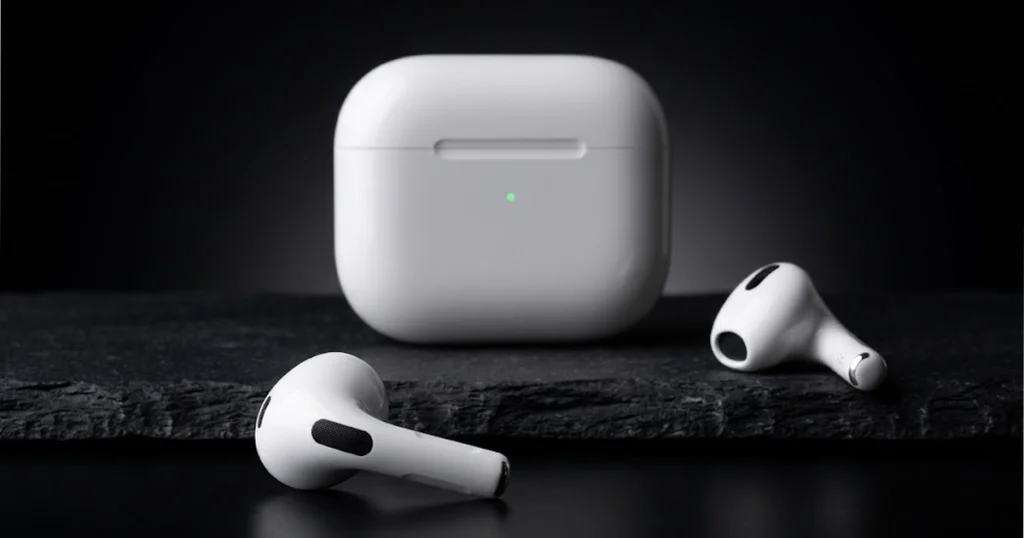
Apple’s new AirPods 5 are a bigger update than their familiar open-ear design initially suggests, especially when paired with the new iPhone 18 Pro Max. The new generation brings Active Noise Cancellation to the $129 model, a redesigned acoustic system, Apple’s H2 chip, Live Translation, Siri AI, Personalized Spatial Audio, improved durability, and a more natural Transparency mode.
There are also two AirPods 5 versions. The standard model costs $129, while the AirPods 5 with Wireless Charging Case costs $149 and adds wireless charging, longer ANC battery life, and volume control by swiping on the stem. Both models become available September 18, 2026. If
Pros
- Open-ear comfort: Lightweight design lets you stay aware of your surroundings.
- Active Noise Cancellation: Helps reduce background noise despite the open-ear fit.
- Improved sound: Better audio quality and clarity than previous generations.
- Apple ecosystem: Easy pairing and seamless switching with Apple devices.
Cons
- Limited noise isolation: The open-ear design cannot block outside sound as effectively as sealed earbuds.
- Premium price: More expensive than many competing open-ear earbuds.
- Best with Apple devices: Some features may be limited when used with non-Apple phones.
But there is an important question behind all these upgrades: Can an open-ear AirPods design really deliver useful ANC, or is the AirPods Pro still the better choice for people who want serious noise isolation?
Here is everything you need to know before buying AirPods 5.
AirPods 5 at a Glance
| Feature | AirPods 5 | AirPods 5 with Wireless Charging Case |
|---|---|---|
| Release date | September 18, 2026 | September 18, 2026 |
| U.S. price | $129 | $149 |
| Design | Open-ear | Open-ear |
| Chip | Apple H2 | Apple H2 |
| ANC | Yes | Yes |
| Adaptive Audio | Yes | Yes |
| Transparency | Yes | Yes |
| Adaptive EQ | Yes | Yes |
| Spatial Audio | Personalized Spatial Audio + dynamic head tracking | Same |
| Live Translation | Yes | Yes |
| Siri AI | Yes, with compatible Apple devices | Yes |
| Bluetooth | 5.3 | 5.3 |
| Earbud weight | 4.3g each | 4.3g each |
| ANC battery | Up to 4 hours | Up to 5 hours |
| Battery with case, ANC | Up to 20 hours | Up to 22 hours |
| Charging | USB-C | USB-C, Apple Watch charger, Qi |
| Find My speaker | No | Yes |
| Volume Swipe | No | Yes |
| Water/dust/sweat resistance | Improved resistance | Improved resistance |
Apple’s technical specifications confirm the H2 chip, Bluetooth 5.3, dual beamforming microphones, Personalized Spatial Audio, Adaptive EQ, Voice Isolation, Live Translation and the different battery and charging configurations.
AirPods 5 Release Date and Price
Apple announced AirPods 5 on September 9, 2026, with pre-orders beginning the same day. Retail availability starts September 18.
The standard AirPods 5 cost $129 in the U.S. The upgraded AirPods 5 with Wireless Charging Case cost $149.
That $20 difference is important because Apple has not simply changed the charging case. The $149 version also gives you longer battery life and volume swipe controls on the stem.
For buyers who specifically want wireless charging or longer battery life, the premium model therefore has a different feature set rather than simply being a cosmetic upgrade.
International pricing varies by country, so buyers outside the U.S. should check Apple’s local store rather than converting the $129 or $149 price directly.
What Is Actually New About AirPods 5?
The biggest changes are not visible from the outside.
Apple redesigned the acoustic architecture with a multiport system, added next-generation Adaptive EQ, improved computational audio, and brought ANC to both versions.
The H2 chip continues to handle much of the intelligent audio processing, while Apple’s newer software features bring Siri AI and Live Translation into the experience.
Apple says the new ANC can remove up to 50% more external noise than AirPods 4 with ANC. That figure comes from Apple’s own testing, so it should be understood as a manufacturer measurement rather than a guarantee that every environment will experience exactly 50% more cancellation.
The other major change is price segmentation. You no longer have to move to a more expensive AirPods model simply to get ANC.
AirPods 5 Design: The Open-Ear Approach Still Matters
AirPods 5 keep Apple’s familiar open-ear design rather than using silicone ear tips.
That distinction is more important than it may sound.
AirPods Pro 3 physically seal the ear canal with interchangeable silicone tips, while AirPods 5 sit in the ear without creating that same sealed environment. The result is a more open feeling and easier awareness of your surroundings, but it also creates a physical limitation for noise isolation.
The AirPods 5 earbuds weigh about 4.3 grams each, according to Apple’s specifications, making them extremely light.
For people who dislike the pressure or sealed sensation of in-ear earbuds, this can be a major advantage.
The trade-off is fit. Open-ear earbuds depend heavily on the shape of your ears, so the same AirPods can feel very secure for one person and less secure for another.
Is AirPods 5 ANC Actually Good?
This is probably the most interesting part of the entire product.
Apple says AirPods 5 deliver up to 1.5x more noise cancellation than AirPods 4 with ANC, using the redesigned acoustic architecture and improved computational audio.
But there is an important distinction between open-ear ANC and sealed-ear ANC.
ANC electronically reduces external sound, but physical isolation still matters. A silicone-sealed earbud can block some outside sound before ANC even begins working. AirPods 5 cannot provide exactly the same physical barrier because they remain open.
That means AirPods 5 can make a noisy environment noticeably quieter while still allowing more environmental sound through than AirPods Pro 3.
Apple’s own comparison is specifically against AirPods 4 with ANC and within the open-ear category. It should not be interpreted as saying AirPods 5 cancel as much sound as every sealed premium earbud.
For an office, café, street walk or everyday commute, that distinction may be acceptable. For someone trying to block an airplane engine or extremely loud surroundings, the sealed AirPods Pro approach remains fundamentally different.
Transparency Mode and Adaptive Audio
AirPods 5 also improve the other side of noise control.
Transparency mode allows surrounding sound into the listening experience, and Apple says the new version represents voices and nearby sounds more naturally.
There is also Adaptive Audio, which dynamically combines ANC and Transparency depending on the environment.
That can be useful when moving between quiet and noisy locations because you do not necessarily have to keep changing listening modes manually.
Conversation Awareness can also lower media volume when you start speaking, making quick conversations easier without completely removing your earbuds.
AirPods 5 Sound Quality
Apple has rebuilt the acoustic system rather than simply adding software features.
The new multiport acoustic architecture works with next-generation Adaptive EQ to adjust the sound based on the way the earbuds sit in different ears. Apple says the result is richer and more detailed audio across a wider range of ear geometries.
The important point is that AirPods 5 remain open-ear earbuds.
You should therefore not expect exactly the same bass response or isolation you get from a sealed in-ear design. Bass perception is particularly affected by how much the ear canal is sealed.
For everyday listening, podcasts, calls, Apple Music and video, the combination of Apple’s acoustic tuning and Adaptive EQ is designed to make the experience more consistent from person to person.
Independent launch coverage has described the sound changes as noticeable but not necessarily transformational compared with AirPods 4. Tom’s Guide, for example, characterized the improvement as relatively modest, particularly for existing AirPods 4 owners.
Adaptive EQ: Why It Matters
Adaptive EQ is not a traditional equalizer where you manually drag bass and treble sliders.
Instead, AirPods use audio processing to adjust the output according to how the earbuds interact with your ears.
That matters more with an open-ear product because fit varies considerably between users.
In other words, two people wearing the same AirPods 5 may not perceive exactly the same sound. Apple’s processing is intended to reduce some of those differences.
Personalized Spatial Audio Gets a Major Role
AirPods 5 support Personalized Spatial Audio with dynamic head tracking.
Compatible movies, shows, music and other content can create a more immersive sound field, while head tracking can make the audio appear anchored to the device or virtual environment.
Apple says Personalized Spatial Audio requires an iPhone with a TrueDepth camera to create the personalized profile, which can then sync across compatible Apple devices.
This is one of the areas where AirPods 5 become more than basic wireless earbuds.
However, Spatial Audio is dependent on compatible content and supported apps. It is not the same thing as magically converting every ordinary stereo recording into a fully immersive mix.
What Does the H2 Chip Actually Do?
The Apple H2 headphone chip is one of the key pieces of the AirPods 5 platform.
It supports computational audio features including ANC, Adaptive Audio, Spatial Audio and other intelligent functions. Apple also lists Voice Isolation and Siri-related capabilities among the AirPods 5 feature set.
The H2 is already used in Apple’s higher-end AirPods products, so putting it into AirPods 5 gives the cheaper model access to a large portion of Apple’s current audio-processing platform.
That does not make AirPods 5 identical to AirPods Pro 3, though. Hardware such as the ear tips, sensors and hearing-health system still separates the two products.
Siri AI Turns AirPods 5 Into More Than Earbuds
AirPods 5 support hands-free access to Apple’s newer Siri AI when paired with a compatible Apple Intelligence-enabled device.
Apple describes Siri AI as a more conversational assistant that can understand personal context and perform actions across supported apps and information on the user’s device.
Apple also supports Siri Interactions, allowing users to respond to Siri prompts with head gestures such as nodding or shaking the head.
But this is not an entirely independent AI system inside the earbuds.
Many of these capabilities depend on the paired Apple device, operating-system version, language and regional availability.
Apple says Siri AI is initially rolling out in beta with iOS 27 in English, with additional languages planned, and some features may not be available in every region.
Live Translation on AirPods 5
Live Translation is another feature that makes the AirPods 5 more interesting than their price suggests.
When properly configured with compatible Apple devices, AirPods can help users hear translated conversations in their preferred language.
Apple says Live Translation requires compatible devices, current software, compatible AirPods firmware, Apple Intelligence and supported languages and regions.
That means the feature should not be treated as something the earbuds perform completely by themselves.
For travelers, international communication and multilingual conversations, it could be useful. But availability depends on Apple’s supported language and regional rollout.
Microphone and Call Quality
AirPods 5 use dual beamforming microphones and support Voice Isolation. Apple also lists studio-quality audio recording among the audio features.
This matters for more than ordinary phone calls.
The microphones can be used for FaceTime, WhatsApp calls, voice messages, online meetings and video recording.
Voice Isolation is particularly relevant in environments where background noise can compete with your voice.
However, microphone performance will still depend on the environment. Wind, traffic, crowds and other loud sounds remain difficult conditions for any small wireless microphone system.
AirPods 5 Controls
Both models support standard AirPods controls through the stem.
You can use the controls for playback, calls, listening modes and Siri-related functions.
The $149 AirPods 5 with Wireless Charging Case adds something more interesting: volume swipe.
You can swipe up or down on the stem to adjust volume.
Apple describes this as the first implementation of this type of volume control in its open-ear AirPods design.
For people who frequently change volume while walking, exercising or commuting, this can be more convenient than reaching for the iPhone.
AirPods 5 vs AirPods Pro 3 vs AirPods 4
| Feature | AirPods 5 | AirPods Pro 3 | AirPods 4 |
|---|---|---|---|
| Design | Open-ear | In-ear with silicone tips | Open-ear |
| ANC | Yes | Yes | Available on ANC model |
| H2 chip | Yes | Yes | Yes |
| Transparency Mode | Yes | Yes | Yes |
| Adaptive Audio | Yes | Yes | Yes |
| Spatial Audio | Yes | Yes | Yes |
| Live Translation | Yes | Yes | Limited by model/software |
| Siri AI | Yes | Yes | Supported with compatible devices |
| Hearing features | Basic accessibility | Advanced hearing features | Basic accessibility |
| Heart-rate sensing | No | Yes | No |
| Battery with ANC | Up to 4–5 hours | Up to 8 hours | Up to 4 hours |
| Wireless charging | $149 model | Yes | ANC model |
| Ear tips | No | Yes | No |
| Water/dust resistance | Improved | IP57 | IP54 |
| Starting U.S. price | $129 | $249 | Older model |
Which AirPods Should You Choose?
AirPods 5: Best suited to people who want Apple’s latest features in a lightweight open-ear design without paying Pro-level pricing.
AirPods Pro 3: Better suited to users who want a sealed fit, stronger physical isolation, longer ANC listening, advanced hearing features and additional health sensors.
AirPods 4: Still worth considering for buyers who want the familiar open-ear AirPods design and don’t need all of the newer AirPods 5 features.
The Biggest Difference
The most important difference isn’t simply the number on the box. AirPods 5 and AirPods 4 use an open-ear design, while AirPods Pro 3 use silicone ear tips that seal the ear canal.
That changes the entire experience. AirPods 5 prioritize comfort and awareness of your surroundings, while the Pro model is designed around stronger isolation, deeper bass and more advanced noise control.
So instead of saying one model is simply “better,” the article should explain which AirPods fits which type of user. This makes the comparison much more useful for readers.
AirPods 5 Battery Life
Battery life is one of the clearest differences between the two models.
AirPods 5 — $129
- Up to 4 hours of listening with ANC
- Up to 20 hours with the charging case and ANC
- USB-C charging
- Around 1 hour of listening from about 5 minutes in the case
AirPods 5 with Wireless Charging Case — $149
- Up to 5 hours of listening with ANC
- Up to 22 hours with the case and ANC
- USB-C charging
- Apple Watch charger support
- Qi-certified wireless charging
- Around 1 hour from about 5 minutes in the case
These are Apple’s stated maximum figures and actual battery life varies according to settings and usage.
One interesting detail is that the premium version gets one extra hour of single-charge ANC listening and two additional hours of total ANC listening with its case.
The Charging Case Is More Important Than It Looks
The standard AirPods 5 case charges through USB-C.
The $149 version also supports Apple Watch chargers and Qi-certified wireless chargers. It includes a speaker for Find My.
That means the more expensive case is useful even if you rarely use wireless charging.
The Find My speaker is another practical difference because it can make locating the case easier.
Find My Support
Apple’s AirPods ecosystem integrates with Find My, making it easier to locate compatible AirPods and cases.
The wireless charging case has a built-in speaker specifically for Find My functionality.
This is one of those features that may seem unimportant when buying the earbuds but becomes extremely useful the first time you cannot remember where you left the case.
Are AirPods 5 Waterproof?
No. They should not be treated as waterproof.
Apple says the new AirPods 5 have improved resistance to dust, sweat and water, but that does not mean they are designed for swimming or submersion.
The important distinction is between water resistance and waterproofing.
For workouts, sweat and ordinary exposure to light rain, the improved durability is useful. For swimming or deliberately exposing the earbuds to large amounts of water, they are not designed for that purpose.
AirPods 5 Accessibility Features
Apple includes accessibility features such as:
- Live Listen
- Headphone levels
- Headphone Accommodations
These features can help users customize or monitor aspects of their listening experience.
But there is a major distinction between AirPods 5 and AirPods Pro 3.
AirPods Pro 3 include dedicated hearing-health features such as Hearing Test, Hearing Aid and Hearing Protection, while AirPods 5 do not.
AirPods 5 Compatibility
AirPods 5 can work with a broad range of Apple devices, including:
- iPhone
- iPad
- Mac
- Apple Watch
- Apple TV
- Apple Vision Pro
Apple also says they can function as Bluetooth headphones with non-Apple devices, although functionality may be limited.
This distinction is important.
The earbuds themselves are Bluetooth headphones, but the full AirPods experience is heavily tied to Apple’s ecosystem.
What Happens If You Use AirPods 5 With Android?
Android users can use AirPods 5 as Bluetooth earbuds, but some Apple-specific functionality will not carry over in the same way.
The biggest reason to buy AirPods 5 is therefore not simply Bluetooth audio.
Features such as Siri AI, Apple Intelligence integration, Personalized Spatial Audio profiles and Apple’s broader ecosystem integration are designed around compatible Apple hardware and software.
If Android is your primary platform, the value proposition becomes more about basic wireless audio, ANC and the physical design rather than the complete Apple experience.
AirPods 5 vs AirPods 4
| Feature | AirPods 5 | AirPods 4 with ANC |
|---|---|---|
| Design | Open-ear | Open-ear |
| H2 chip | Yes | Yes |
| ANC | Improved | Yes |
| Adaptive Audio | Yes | Yes |
| Spatial Audio | Yes | Yes |
| Live Translation | Yes | Not originally positioned with this feature |
| Siri AI | Yes | Supported through compatible software/features |
| ANC battery | Up to 4h | Up to 4h |
| Case ANC battery | Up to 20h | Up to 20h |
| Wireless charging | $149 model | ANC model |
| Volume Swipe | $149 model | No |
| Water/dust resistance | Improved | IP54 |
| Price | From $129 | Older model |
The upgrade is therefore less about a completely new physical design and more about bringing Apple’s newer platform features into the standard AirPods line.
Apple specifically says AirPods 5 provide up to 50% more noise reduction than AirPods 4 with ANC.
For someone already happy with AirPods 4, the decision is less straightforward because the basic listening experience and overall shape remain familiar. Tom’s Guide also describes the sound improvement as relatively modest compared with the feature additions.
AirPods 5 vs AirPods Pro 3
This is where the choice becomes much clearer in terms of design philosophy.
| Feature | AirPods 5 | AirPods Pro 3 |
|---|---|---|
| Design | Open-ear | Sealed in-ear |
| U.S. starting price | $129 | $249 |
| ANC | Yes | Yes |
| H2 | Yes | Yes |
| Spatial Audio | Yes | Yes |
| Live Translation | Yes | Yes |
| Siri AI | Yes | Yes |
| Hearing Test | No | Yes |
| Hearing Aid | No | Yes |
| Hearing Protection | No | Yes |
| Heart-rate sensing | No | Yes |
| ANC battery | 4–5h | Up to 8h |
| Case ANC battery | 20–22h | Up to 24h |
| Water/dust resistance | Improved | IP57 |
| Ear tips | No | Yes |
| Wireless charging | $149 model | Yes |
Apple’s current specifications show that AirPods Pro 3 add hearing-health features, heart-rate sensing, more sensors, IP57 protection and longer battery life.
The AirPods 5’s advantage is the open-ear experience and lower entry price.
The Pro 3 is built around a different objective: stronger isolation, sealed fit, additional sensors and more advanced health-related capabilities.
So this is not simply a question of which model has more features. It is a question of which design you actually want to wear.
AirPods 5 vs Sony and Other Premium Earbuds
AirPods 5 also face competition from earbuds that focus heavily on sound quality, ANC, battery life, EQ customization and Android compatibility.
Some premium Sony, Bose, Sennheiser and other models use sealed designs and can therefore take advantage of physical isolation alongside ANC.
That gives them an inherent advantage for users who want maximum noise blocking.
AirPods 5 instead concentrate on:
- Open-ear comfort
- Apple ecosystem integration
- H2 processing
- Spatial Audio
- Siri AI
- Live Translation
- Lightweight design
- Easy device integration
Battery is another area where premium sealed competitors can have an advantage. Apple’s own AirPods Pro 3, for example, are rated for up to eight hours with ANC, compared with four hours for standard AirPods 5 and five hours for the wireless-charging version.
The Good Things About AirPods 5
Open-ear comfort
There is no silicone tip pressing into the ear canal.
ANC at $129
This is arguably the most important pricing change. Apple has made ANC available at the starting price.
H2 chip
AirPods 5 inherit Apple’s current-generation H2 audio platform.
Better acoustic architecture
The new multiport system and Adaptive EQ are designed to improve consistency and detail.
Live Translation
A feature previously associated more strongly with Apple’s higher-end ecosystem is now available on AirPods 5 with compatible devices.
Siri AI
The earbuds can act as a hands-free interface to Apple’s newer AI-powered Siri experience.
Spatial Audio
Personalized Spatial Audio and dynamic head tracking are included.
Better durability
Apple has increased resistance to dust, sweat and water compared with AirPods 4.
$149 wireless model
The premium version combines wireless charging, longer battery life and volume swipe.
The Bad Things About AirPods 5
Open-ear ANC has physical limits
Even excellent ANC cannot completely erase the difference between an open earbud and a sealed in-ear design.
Battery life remains modest
Four to five hours with ANC is reasonable, but some competitors and AirPods Pro 3 offer longer continuous listening.
No interchangeable ear tips
Users who want a customized sealed fit do not get that option.
Android loses much of the ecosystem advantage
The earbuds can work over Bluetooth, but Apple’s deeper features are designed around Apple devices.
$149 is not just about charging
If you want volume swipe and longer battery life, you need the more expensive version.
No Pro-level hearing features
AirPods 5 do not include the Hearing Test, Hearing Aid and Hearing Protection features found on AirPods Pro 3.
The $20 Question: Which AirPods 5 Model Makes More Sense?
The standard $129 AirPods 5 gives you the core experience:
- ANC
- H2
- Adaptive Audio
- Transparency
- Spatial Audio
- Live Translation
- Siri AI
- USB-C
- Four hours of ANC listening
The $149 model adds:
- Five hours of ANC listening
- Up to 22 hours with the case
- Wireless charging
- Apple Watch charging
- Qi charging
- Find My speaker
- Volume Swipe
So the $20 difference is really about convenience and battery.
If you do not care about wireless charging or stem volume control, the standard model contains most of the important AirPods 5 technology.
What Apple Doesn’t Tell You About AirPods 5
The headline features make AirPods 5 look very close to the Pro experience, but several differences remain important.
First, ANC does not change the physics of an open-ear design. AirPods 5 can electronically reduce external noise, but they do not create the same physical seal as AirPods Pro 3.
Second, fit still matters. Because there are no silicone tips, your ear shape affects stability and how you perceive the sound.
Third, many smart features depend on another Apple device. Siri AI and Live Translation are not simply independent AI functions running entirely inside the earbuds.
Fourth, regional and language restrictions matter. Apple specifically notes that Apple Intelligence and Live Translation features are not available in every language or region.
Finally, battery claims are usage-dependent. Apple’s four-, five-, 20- and 22-hour figures are maximum stated figures under specified conditions, not guarantees for every listening scenario.
Who Should Buy AirPods 5?
AirPods 5 make particular sense for people who:
- Already use an iPhone and other Apple devices
- Prefer an open-ear fit
- Do not like silicone ear tips
- Want ANC without moving to AirPods Pro
- Want Spatial Audio
- Want Live Translation
- Want Siri AI through their earbuds
- Frequently make calls
- Want lightweight earbuds for everyday use
- Prefer Apple’s automatic device switching and ecosystem integration
The $149 version is especially relevant if wireless charging, longer ANC battery life and volume swipe matter to you.
Who Should Skip AirPods 5?
You may want to look at other options if your priority is:
- Maximum noise isolation
- Very strong bass from a sealed fit
- The longest possible single-charge battery
- Extensive manual EQ control
- Android-first use
- Hearing-health features
- Heart-rate tracking
- Replaceable ear tips
- A completely sealed in-ear experience
In those cases, the AirPods Pro 3 or premium competing earbuds occupy a different category.
Final Verdict: AirPods 5 Are More Than a Simple AirPods 4 Refresh
AirPods 5 are an interesting expansion of Apple’s standard AirPods line because Apple has moved several advanced features down to a much lower price.
The biggest change is not the appearance. It is the combination of ANC, H2 processing, Adaptive Audio, Spatial Audio, Live Translation and Siri AI starting at $129.
The open-ear design remains both the product’s biggest attraction and its biggest limitation. It is potentially more comfortable for people who dislike sealed earbuds, but it cannot completely replicate the physical isolation of AirPods Pro 3.
The $149 model is effectively the convenience-focused version, adding wireless charging, volume swipe and longer ANC battery life.
For an iPhone user who specifically wants open-ear comfort plus Apple’s newer intelligent audio features, AirPods 5 create a very different proposition from previous non-Pro AirPods. For someone whose priority is maximum isolation, longer battery life, hearing-health functions or a sealed in-ear fit, the AirPods Pro 3 remains a separate category rather than simply a more expensive version of the same idea.
The standard model provides up to 4 hours with ANC on one charge. The wireless-charging model provides up to 5 hours.
No. Wireless charging is exclusive to the $149 AirPods 5 with Wireless Charging Case.
No. They have improved resistance to dust, sweat and water, but they should not be treated as waterproof.
Yes, as Bluetooth headphones, but Apple says functionality may be limited on non-Apple devices.
They include accessibility features such as Live Listen and Headphone Accommodations, but they do not have the dedicated Hearing Test, Hearing Aid and Hearing Protection features available on AirPods Pro 3.
No. Heart-rate sensing is available on AirPods Pro 3, not AirPods 5.
They introduce stronger ANC, Live Translation, newer software capabilities, improved acoustic architecture and other changes. However, the overall open-ear design remains familiar, so AirPods 4 owners should consider whether those specific improvements matter enough to upgrade.
Table of Contents
- AirPods 5 at a Glance
- Live Translation on AirPods 5
- Microphone and Call Quality
- AirPods 5 Controls
- AirPods 5 vs AirPods Pro 3 vs AirPods 4
- AirPods 5 Battery Life
- The Charging Case Is More Important Than It Looks
- Find My Support
- Are AirPods 5 Waterproof?
- AirPods 5 Accessibility Features
- AirPods 5 Compatibility
- What Happens If You Use AirPods 5 With Android?
- AirPods 5 vs AirPods 4
- AirPods 5 vs AirPods Pro 3
- AirPods 5 vs Sony and Other Premium Earbuds
- The Good Things About AirPods 5
- The Bad Things About AirPods 5
- The $20 Question: Which AirPods 5 Model Makes More Sense?
- What Apple Doesn’t Tell You About AirPods 5
- Who Should Buy AirPods 5?
- Who Should Skip AirPods 5?
- Final Verdict: AirPods 5 Are More Than a Simple AirPods 4 Refresh



Add your first comment to this post