
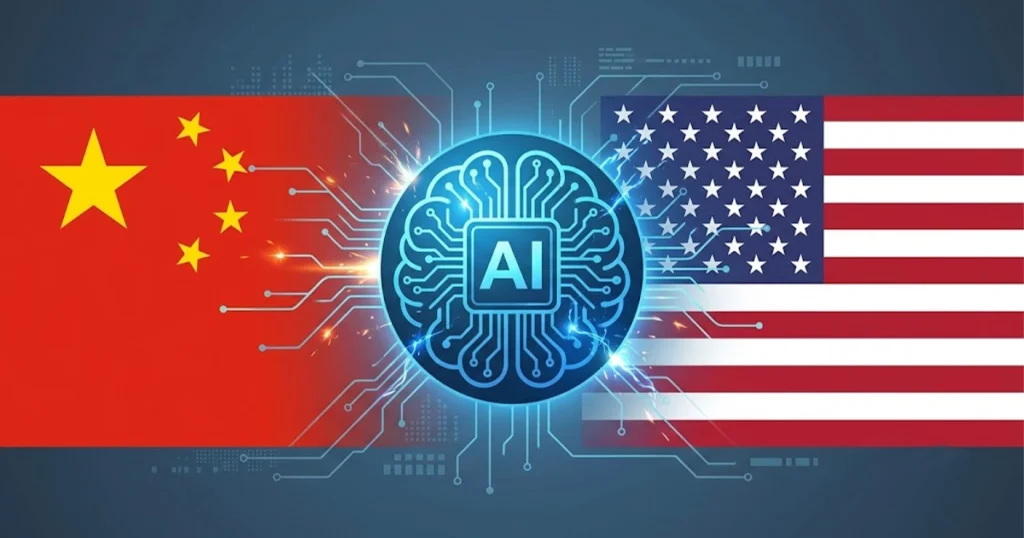
China is strengthening its commitment to China Pushes Open-Source AI as competition with the United States enters a new phase. During the 2026 World Artificial Intelligence Conference (WAIC) in Shanghai, Chinese President Xi Jinping presented open-source AI as a way to make advanced technology more accessible while calling for greater international cooperation on AI development and governance.
The announcement comes as both China and the United States invest heavily in AI research, advanced computing infrastructure, and AI regulation. While the US continues to lead many frontier AI technologies through companies such as OpenAI, Anthropic, Google, and Meta, China is rapidly expanding its AI ecosystem with companies including DeepSeek, Alibaba, Baidu, Zhipu AI, and Moonshot AI.
For businesses, developers, governments, and consumers worldwide, the growing rivalry between the world’s two largest economies is shaping the future of artificial intelligence.
Background
The competition between China and the United States over AI has intensified over the past several years. AI has become one of the most strategically important technologies, with applications ranging from scientific research and healthcare to manufacturing, cybersecurity, education, and national security.
The United States has introduced export controls that limit China’s access to advanced AI chips and certain semiconductor technologies. These restrictions are intended to slow China’s progress in developing cutting-edge AI systems. China, meanwhile, has invested heavily in domestic AI research, chip development, cloud computing, and open-source AI models to reduce dependence on foreign technology.
Chinese AI companies have increasingly adopted an open-source strategy, allowing developers around the world to download, modify, and build upon many of their AI models. This approach differs from many leading US AI companies, which primarily offer their most advanced models through commercial APIs and subscription services, although some American companies also release open-weight or open-source models.
What Happened?
At the World Artificial Intelligence Conference in Shanghai, President Xi Jinping called for wider international cooperation in AI and promoted open-source AI as a shared global resource. He warned against limiting access to AI technologies and argued that AI should benefit all countries rather than remain concentrated among a small number of nations.
China also announced the launch of the World AI Cooperation Organization (WAICO), an international initiative involving multiple participating countries that aims to strengthen cooperation on AI development and governance. The initiative reflects Beijing’s ambition to play a larger role in setting global AI standards.
Alongside these policy announcements, Chinese AI startup Moonshot AI introduced Kimi K3, a new open-source large language model that the company says is designed to compete with leading AI systems developed in the United States. Company performance claims have attracted significant attention, although independent evaluations are still developing.
Why It Matters
China’s growing support for open-source AI could significantly influence the future of global AI development.
For developers, open-source models provide opportunities to study AI systems, customize applications, and build new products without relying entirely on commercial AI platforms.
Businesses may benefit from lower development costs and greater flexibility when integrating AI into their products and services.
Governments may view China’s approach as an alternative model for AI cooperation, particularly in developing countries seeking affordable AI technologies.
For the broader technology industry, increased competition between China and the United States could accelerate innovation while also increasing geopolitical tensions surrounding advanced technologies.
Key Players
China
China aims to become a global AI leader while expanding international cooperation through open-source technologies. The government is encouraging domestic AI innovation despite ongoing export restrictions affecting advanced chips.
United States
The United States remains a leader in frontier AI research, supported by companies such as OpenAI, Anthropic, Google, Meta, Microsoft, and NVIDIA. US policy has increasingly focused on maintaining technological leadership while protecting national security through export controls on advanced AI hardware.
Chinese AI Companies
Companies including DeepSeek, Moonshot AI, Alibaba, Baidu, Zhipu AI, and MiniMax have accelerated AI model development over the past two years. Several have released open-source or open-weight models that have gained attention from developers worldwide.
Industry Analysis
The global AI market is becoming increasingly competitive as different development strategies emerge.
China’s biggest strength is its growing open-source ecosystem, which encourages widespread adoption, faster experimentation, and lower deployment costs. This strategy may appeal particularly to startups, universities, and developing nations seeking affordable AI solutions.
The United States continues to hold important advantages in advanced AI research, semiconductor technology, cloud infrastructure, venture capital, and many of the world’s leading frontier AI companies.
However, export restrictions, supply chain pressures, and geopolitical competition are creating new challenges for both countries. China continues working to strengthen domestic AI capabilities, while US companies face growing international competition from increasingly capable Chinese AI models.
Expert Opinions
Speaking at WAIC, President Xi Jinping said countries should work together to promote AI development and prevent unequal access to the technology. He also emphasized that AI governance should balance innovation with safety and international cooperation.
Industry analysts note that China’s expanding open-source AI ecosystem is becoming a significant factor in the global AI race. While American companies continue to lead in several frontier AI capabilities, Chinese open-source models are gaining wider adoption and increasing competitive pressure across the industry.
Challenges and Risks
Despite the momentum behind open-source AI, several challenges remain.
Governments continue debating how to balance innovation with national security. More accessible AI models can accelerate research and development, but they also raise concerns about misuse, cybersecurity, misinformation, and AI safety.
Export restrictions on advanced chips remain another major challenge for Chinese AI companies. At the same time, growing geopolitical tensions may complicate future international cooperation on AI standards and governance. Privacy protection, responsible AI development, and regulatory oversight will remain central issues as AI capabilities continue to improve.
Future Outlook
China is expected to continue expanding its open-source AI strategy while increasing investment in domestic AI infrastructure and international partnerships.
The United States is also likely to continue investing in frontier AI models, advanced semiconductor technologies, and AI safety research. Competition between the two countries is expected to drive rapid technological progress while increasing discussions around global AI governance.
Future developments may include additional open-source AI releases, new international cooperation initiatives, and further policy changes related to AI regulation and advanced computing technologies.
Final Verdict
China’s latest push for open-source AI reflects a broader strategy to expand its influence in the rapidly evolving artificial intelligence landscape. By promoting accessible AI technologies and international cooperation, Beijing is presenting an alternative vision for how AI should be developed and shared globally.
Meanwhile, the United States continues to focus on maintaining its leadership in advanced AI research while protecting critical technologies through export controls and strategic investments. As both countries pursue different approaches, their competition is likely to shape the future of AI innovation, regulation, and global technology leadership for years to come.




Add your first comment to this post