
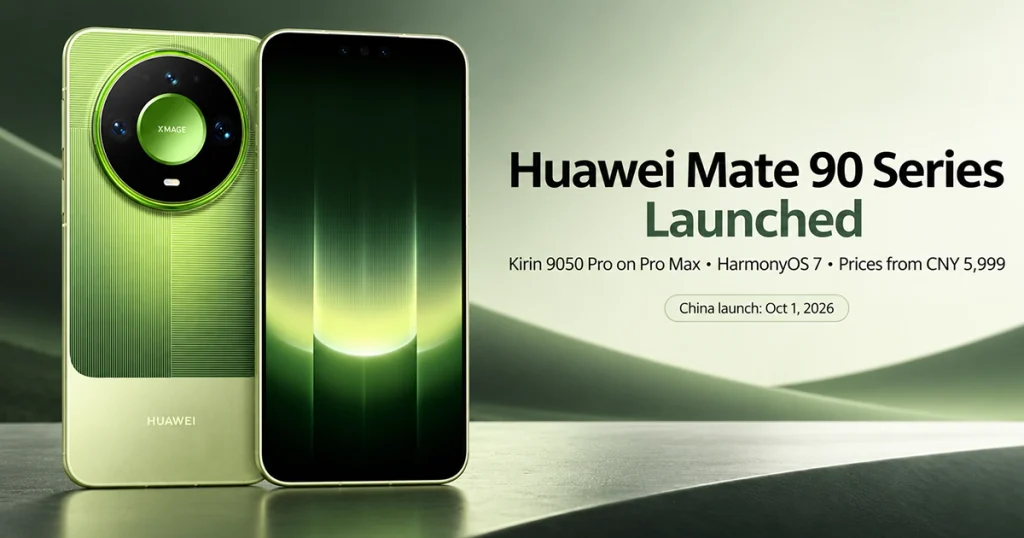
The Huawei Mate 90 series is now official in China, bringing new Kirin processors, HarmonyOS 7, larger batteries, upgraded cameras and several changes over last year’s Mate 80 family.
Huawei launched the new lineup on October 1, 2026. It includes the Huawei Mate 90, Mate 90 Pro, Mate 90 Pro Max and Mate 90 RS Ultimate Design. One important distinction is that the much-discussed Kirin 9050 Pro is not used across the entire range: the standard Mate 90 uses the Kirin 9030, while the Mate 90 Pro has the Kirin 9035. The Kirin 9050 series is reserved for higher-end Mate 90 Pro Max configurations.
Huawei has also moved the family to HarmonyOS 7, while increasing battery capacity substantially compared with the Mate 80 generation.
Huawei Mate 90 series at a glance
| Model | Processor | Display | Battery | Starting price |
|---|---|---|---|---|
| Huawei Mate 90 | Kirin 9030 | 6.75-inch LTPO OLED | 6,600mAh | CNY 5,999 |
| Huawei Mate 90 Pro | Kirin 9035 | 6.75-inch dual-layer LTPO OLED | 6,600mAh | CNY 6,999 |
| Huawei Mate 90 Pro Max | Kirin 9050 series, depending on configuration | 6.9-inch dual-layer LTPO OLED | 6,800mAh | Higher-tier model |
| Mate 90 RS Ultimate Design | Flagship Mate 90 platform | 6.9-inch class | 6,800mAh class | Premium model |
Huawei’s official purchasing guide confirms that the regular Mate 90 starts at CNY 5,999 for 12GB RAM and 256GB storage, while the Mate 90 Pro starts at CNY 6,999. Sales of those configurations began in China on October 1.
The Kirin 9050 Pro is the biggest technology story — but only on the top models
Much of the attention surrounding the Huawei Mate 90 launch has focused on Huawei’s new Kirin 9050 Pro.
Reuters reports that the chip uses a new architecture Huawei calls LogicFolding, designed to reorganize chip wiring in three dimensions. Huawei is using the approach as it continues developing its own semiconductor technology while facing restrictions on access to some advanced chip-manufacturing equipment.
Huawei says the Mate 90 Pro Max provides a significant overall performance improvement compared with its predecessor. Reuters reports Huawei’s claim of a 31% performance increase for the Pro Max, but that number should be treated as a manufacturer performance claim rather than an independent benchmark result.
Huawei’s own Pro Max specifications list both Kirin 9050 Pro and Kirin 9050 variants, meaning buyers should check the exact memory and model configuration rather than assuming every Mate 90 Pro Max contains the Pro chip.
The cheaper Mate 90 models use different Kirin chips
The regular Huawei Mate 90 uses the Kirin 9030, which Huawei says delivers a 27% improvement in overall performance compared with the Mate 80 in its own testing.
The Mate 90 Pro moves to the Kirin 9035. Huawei does not expose the same level of technical detail that companies such as Qualcomm or Apple normally publish for their flagship chips, so independent testing will still be important before drawing firm conclusions about CPU, GPU, efficiency and sustained gaming performance.
HarmonyOS 7 comes standard
All Mate 90 models ship with HarmonyOS 7.0, replacing HarmonyOS 6 on the Mate 80 generation.
Huawei highlights several software features on the Mate 90, including improved device-to-device sharing, AI-powered Xiaoyi functions, communication sharing between compatible Huawei devices and new system integrations.
For example, Huawei says Xiaoyi can collect and organize information saved from supported apps, assist with calls, summarize conversations and trigger actions based on content displayed on screen. Some functions require software updates or depend on compatible services and devices.
HarmonyOS 7 isn’t limited to the Mate 90 series. Huawei’s current compatibility list also includes devices from the Mate 80, Mate 70, Pura 90, Pura 80, nova and Mate X families.
Cameras: the Mate 90 gets a much more serious telephoto camera
Camera upgrades vary significantly by model.
The standard Huawei Mate 90 has:
- 50MP RYYB main camera with variable f/1.4-f/4.0 aperture and OIS
- 40MP ultrawide camera
- 50MP RYYB telephoto camera with OIS
- approximately 4x optical zoom
- Huawei’s third-generation Red Maple color-imaging system
That telephoto camera represents a major hardware change from the Mate 80, which used a 12MP 5.5x periscope camera.
The Mate 90 Pro keeps a similar basic camera arrangement but adds a 50MP macro-capable telephoto camera with approximately 4x optical zoom.
Mate 90 Pro Max jumps to a 200MP telephoto camera
The Huawei Mate 90 Pro Max pushes the camera hardware considerably further.
Huawei lists:
- 50MP RYYB main camera with variable f/1.4-f/4.0 aperture
- 40MP RYYB ultrawide camera
- 200MP RYYB telephoto camera
- OIS on the main and telephoto cameras
- approximately 4x optical zoom
- up to 100x digital zoom
- third-generation Red Maple color camera
Huawei also promotes an 18 EV high-dynamic-range main-camera system and its latest XMAGE imaging platform on the Pro Max. Those figures are Huawei claims and should not be interpreted as independent camera-test results.
Huawei separately announced an update to its XMAGE imaging brand alongside the Mate 90 launch.
Huawei also made an external camera for the Mate 90 Pro Max
One of the more unusual additions is the Huawei Ruiying Z10 modular camera, supported by selected Mate 90 Pro Max and Mate 90 RS configurations.
Unlike a simple clip-on lens, the Z10 is effectively a separate camera module with its own 50MP RYYB sensor and zoom optics. Reporting from The Verge says it covers an equivalent focal range of roughly 24-240mm and attaches directly to compatible phones.
It is a specialist accessory rather than something most Mate 90 buyers will need, but it shows how aggressively Huawei is positioning the top Mate models around photography.
Battery life gets one of the clearest upgrades
Battery capacity is one of the easiest Mate 90 improvements to quantify.
The standard Huawei Mate 90 has a 6,600mAh battery, compared with 5,750mAh in the Mate 80. Both support up to 66W wired charging and 50W Huawei wireless charging.
That is an increase of 850mAh, or roughly 15% in nominal battery capacity.
The Mate 90 Pro also uses a 6,600mAh battery, while increasing wired charging to 100W. The previous Mate 80 Pro had a 5,750mAh battery.
At the top of the range, the Mate 90 Pro Max has a 6,800mAh battery, 100W wired charging and 50W wireless charging.
Actual endurance will depend on display brightness, cellular use, cameras, gaming and software optimization, so battery capacity alone cannot tell us exactly how long each model lasts in everyday use.
Display upgrades focus on brightness and durability
The standard Mate 90 uses a 6.75-inch LTPO OLED display with a 1-120Hz adaptive refresh rate and a resolution of 2832 × 1280. Huawei also upgrades it from second-generation Kunlun glass on the Mate 80 to third-generation Kunlun glass.
The Mate 90 Pro adds a dual-layer OLED panel while retaining the 6.75-inch size and adaptive 1-120Hz refresh rate.
The Pro Max moves to a 6.9-inch dual-layer OLED, with Huawei advertising peak brightness of as much as 12,000 nits under the company’s specified testing conditions. That figure represents peak behavior rather than normal full-screen everyday brightness.
Huawei Mate 90 vs Mate 80: what actually changed?
The biggest changes are easier to see when the two generations are placed side by side.
| Feature | Huawei Mate 80 | Huawei Mate 90 |
|---|---|---|
| Processor | Kirin 9020 | Kirin 9030 |
| OS | HarmonyOS 6 | HarmonyOS 7 |
| Display | 6.75-inch LTPO OLED | 6.75-inch LTPO OLED |
| Battery | 5,750mAh | 6,600mAh |
| Wired charging | 66W | 66W |
| Main camera | 50MP variable aperture | 50MP variable aperture |
| Telephoto | 12MP, 5.5x | 50MP, approx. 4x |
| Color system | 2nd-gen Red Maple | 3rd-gen Red Maple |
| Glass | 2nd-gen Kunlun | 3rd-gen Kunlun |
| Starting price | CNY 5,499 at launch | CNY 5,999 |
The biggest practical changes on the standard phone are therefore the much larger battery, stronger telephoto camera, newer Kirin processor, third-generation protective glass and HarmonyOS 7.
The price has also increased: the Mate 80 launched from CNY 5,499, while the Mate 90 starts at CNY 5,999.
Huawei Mate 90 price
Huawei’s official China launch pricing begins as follows:
Huawei Mate 90
- 12GB + 256GB: CNY 5,999
- 12GB + 512GB: CNY 6,999
- 12GB + 1TB: CNY 8,499
Huawei Mate 90 Pro
- 12GB + 256GB: CNY 6,999
- 12GB + 512GB: CNY 7,999
Huawei also offers higher-memory Mate 90 Pro configurations.
Reuters reported the Mate 90 Pro Max at CNY 9,999 for the configuration discussed in its launch coverage.
Prices converted directly into dollars, pounds, rupees or euros can be misleading because international models — if launched — may have different taxes, configurations and regional pricing.
Is the Huawei Mate 90 available globally?
Not yet, based on the information confirmed at launch.
Huawei’s October 1 announcement and purchasing information cover the Chinese market, and no broad international Mate 90 launch schedule has been confirmed in the official information reviewed for this article.
That means claims about a specific UK, European, Middle Eastern, Pakistani or other global release date should currently be treated as unconfirmed unless Huawei announces one.
Previous Mate generations eventually reached some markets outside China, but that does not guarantee the Mate 90 will follow exactly the same schedule.
This is one of the most important details to watch after launch.
What about Google apps?
The Chinese Mate 90 family runs Huawei’s HarmonyOS ecosystem rather than Google’s standard Android distribution.
Anyone considering importing a Mate 90 should therefore check app compatibility, local banking apps, payment services, eSIM support, network bands and other regional requirements before buying.
Some features advertised on Huawei’s Chinese pages — particularly satellite communication and carrier-dependent functionality — are specifically limited to supported networks or mainland China.
That matters more for international buyers than another small difference in processor or camera specifications.
An unusual Pro Max feature: three active SIM connections
Huawei’s official Pro Max specifications allow up to two physical SIM profiles plus eSIM configurations, and GSMArena reports that certain Mate 90 Pro Max configurations can maintain three active connections simultaneously, subject to carrier conditions in China.
It is a distinctive feature, although its usefulness outside China will depend heavily on local carrier and eSIM support.
What matters most about the Huawei Mate 90 launch?
The Huawei Mate 90 is not simply a yearly camera refresh.
The standard model moves from a 5,750mAh to a 6,600mAh battery, upgrades from Kirin 9020 to Kirin 9030, replaces its 12MP telephoto camera with a 50MP unit and ships with HarmonyOS 7.
Higher models make larger jumps, including dual-layer OLED screens, 100W charging and, on the Pro Max, the Kirin 9050 series and a 200MP telephoto camera.
The Kirin 9050 Pro and LogicFolding architecture are arguably the broader technology story because they show Huawei continuing to pursue new ways to improve domestic semiconductor performance despite manufacturing restrictions. But independent testing will be needed to determine how Huawei’s performance claims translate into real-world speed, gaming, heat and power efficiency.
For buyers outside China, however, the biggest unanswered question is much simpler: when — and where — will Huawei release the Mate 90 internationally?
Huawei had not confirmed a broad global release schedule at the time this article was prepare.


Add your first comment to this post